
Of all the decisions that go into dressing a window, the finial is the one most likely to be underestimated. It is small. It sits at the end of the pole. And yet it is the detail that gives your window dressing its character, anchoring the look to a particular style and, in the best cases, completing a room in a way that nothing else quite can.
At Made by the Forge, our finials are hand-forged individually by our blacksmiths in Suffolk, using the same traditional techniques as the poles they accompany. Here is everything you need to know to choose the right one.
A Brief History of the Finial
The word finial comes from the Latin finalis, meaning final or end. Finials have appeared on buildings, furniture, and decorative objects for centuries, from the carved stone pinnacles of Gothic cathedrals to the carved wooden bedposts of Tudor manor houses. Their purpose has always been both functional and decorative: to finish something cleanly, and to do so with intention.
On curtain poles, the finial became a significant design element during the Georgian and Victorian eras, when the window dressing was considered a mark of household taste and refinement. The choice of finial signalled something about the occupant’s aesthetic sensibility, their interest in classical motifs, their appreciation for craftsmanship, or their preference for restraint over ornament. That tradition is very much alive today.
The Made by the Forge Finial Collection
Our collection currently includes eight hand-forged finial designs, each with its own character and heritage:
Cannonball
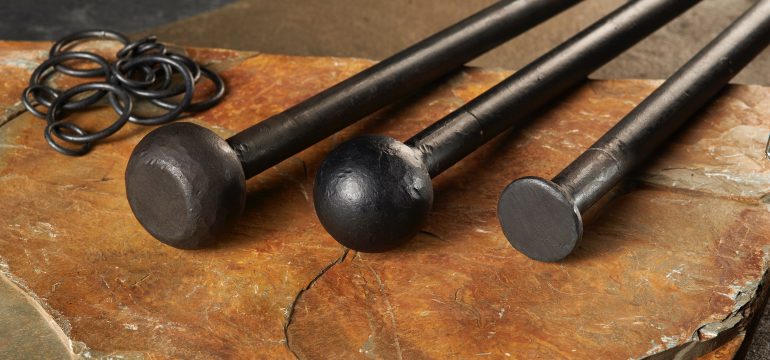
The Cannonball is our most classic and widely loved design. Clean, spherical, and satisfyingly substantial, it suits almost any interior context, from period cottages to contemporary spaces that value honest materials over decorative flourish. It is the finial that disappears into a room in the best possible way, doing its job without drawing attention to itself.
Ram’s Horn
A beautifully expressive design with deep roots in traditional blacksmithing. The Ram’s Horn has a sculptural quality that makes it as much a piece of ironwork as a functional fitting. It works particularly well in homes with exposed beams, stone floors, or a strong sense of rural character, though it can also provide an interesting counterpoint in a more refined setting.
Thumper
The Thumper has a distinctive forged profile that catches the light and rewards close inspection. It is a design that reflects the blacksmith’s art: shaped by hand, visually interesting at every angle, and clearly made rather than manufactured. A strong choice for those who want their curtain pole to be noticed.
Button
Simple, refined, and quietly confident. The Button finial is for those who prefer understatement. It provides a clean termination to the pole without competing for attention, making it an excellent choice for rooms with strong pattern, colour, or furniture that you want to remain the focal point.
Ball and Twisted Cage
The Ball and Twisted Cage brings additional movement and detail to the pole. The Ball is a close relative of the Cannonball but with a slightly different proportion and feel. The Twisted Cage is a more elaborate design that showcases the blacksmith’s skill in working iron into complex forms. Both are well suited to rooms where a little more decorative energy is welcome.
Alexandra
A design rooted in classical British ironwork. The Alexandra pairs a traditional collar with a beautifully proportioned steel ball, the two elements combining to create a finial that feels both considered and complete. It suits period properties particularly well, though it brings the same quiet distinction to any room that values understated elegance over decoration for its own sake.
Houghton
Where the Button opts for restraint, the Houghton makes a bolder statement. This is a substantially thicker design with a real solidity that sets it apart from anything else in the collection. It works particularly well on wider windows and in rooms with generous proportions, where a more substantial fitting feels not just appropriate but exactly right.
Levington
Unlike anything else in the range. The Levington merges three button-like forms along a single axis to create a dumbbell-shaped finial of real originality, unmistakably hand-forged and impossible to mistake for anything mass-produced. For those who want their curtain pole to be genuinely distinctive, it is the natural choice.
Matching Finials to Interior Styles
As a general guide:
- Country, cottage, or farmhouse interiors: Ram’s Horn, Cannonball, Thumper, Levington
- Period, Georgian, or Victorian rooms: Cannonball, Alexandra, Ball, Twisted Cage, Houghton
- Contemporary or Scandi-influenced spaces: Button, Cannonball, Alexandra
- Industrial or loft-style interiors: Thumper, Ram’s Horn, Houghton
- For something genuinely one of a kind, in any setting: Levington
That said, rules in interior design exist to be questioned. Some of our most striking installations come from customers who chose a finial that surprised them.
Finishes: Matt Black or Natural Beeswax
All of our finials are available in two finishes: a matt black paint and a natural beeswax. The matt black is clean, contemporary, and pairs well with dark frames, modern kitchens, and rooms with a strong, considered palette. The beeswax finish reveals the natural warmth of the iron beneath, giving the pole a softer, more aged quality that suits period properties and natural material interiors particularly well. You can learn more about the difference in our post.


Leave a Reply
You must be logged in to post a comment.